Pests and diseases
There’s nothing worse than raising a plant with care and affection only to find it half dead or half eaten, covered with bugs!
Below are a few tips on the most common pests and diseases. Hopefully you will never have to use it, but if you do, we hope it will be useful.
General tips
- Remove dead leaves as this helps prevent mould and reduces hiding places for pests.
- Keep succulents on the dry side. Generally let the soil dry out between watering. Wet soil can attract fungus gnats or mealybugs and too much water can cause the plants to rot.
- Adding a layer of gravel or grit can prevent gnats from reaching the soil to lay eggs.
- Quarantine new plants. To ensure that you do not introduce pests to your healthy plants, check new plants carefully and quarantine them until you are sure they are pest-free. If you do find pests on new plants, treat the problem immediately or discard the plant.
- A healthy plant is far better at resisting pests and diseases than a sickly one. Be sure to check out our How to care for your succulents article for more tips.
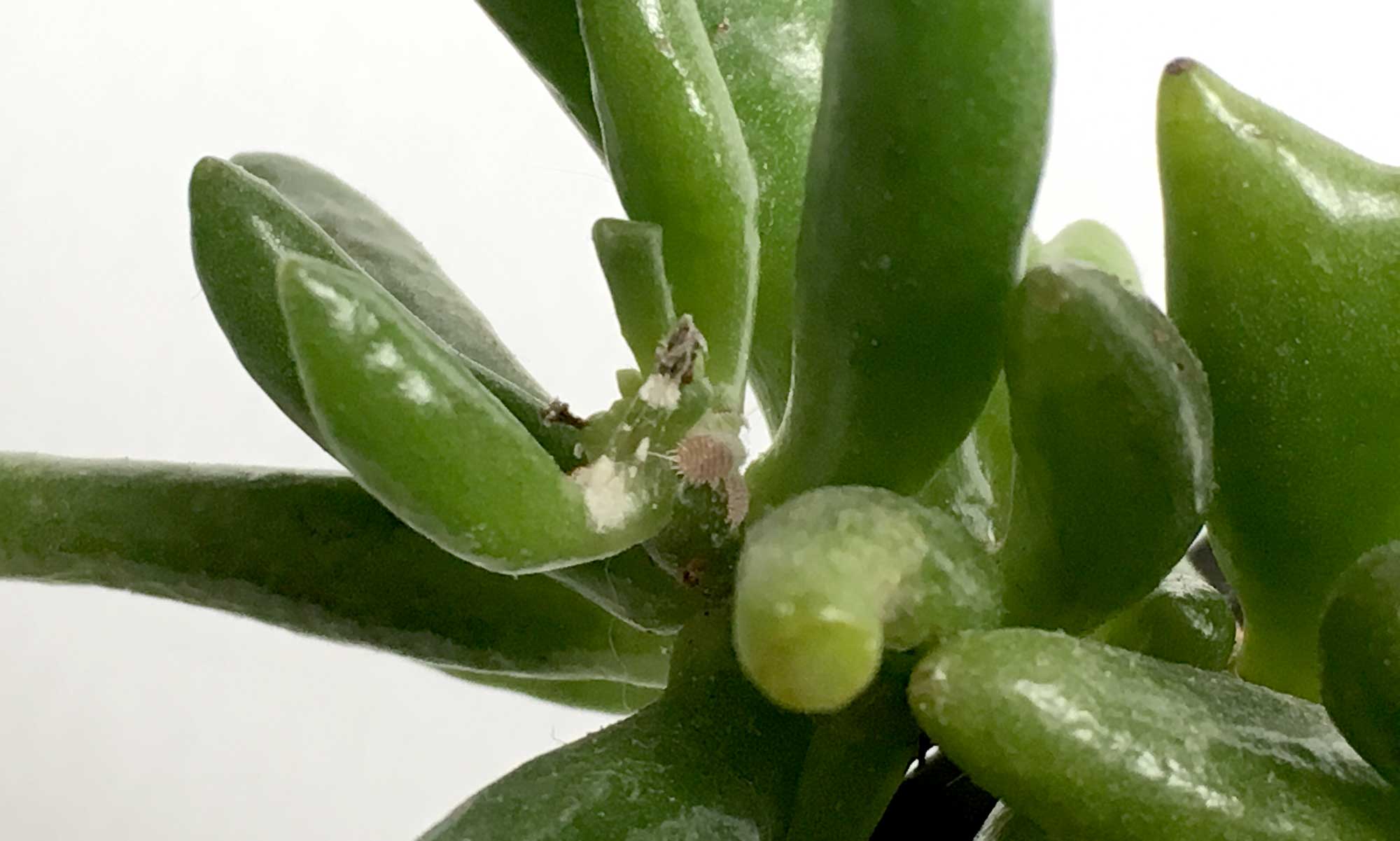
Mealybugs
Mealybugs are common sap-feeding insects that are found in moist, warm climates, but also at home on greenhouse or house plants. Mealybugs weaken plants and excrete a sticky substance (honeydew) on foliage, which allows the growth of sooty moulds. They also secrete a white, fluffy looking wax that coats their bodies and conceals their eggs. If not treated quickly they can soon strip a succulent of its leaves and spread to other plants.
We hate these bugs!
How to control
- Rubbing alcohol. We’ve found the best way of getting rid of these pesky critters is by dabbing them with 70% rubbing alcohol on a cotton bud. They pretty much dissolve on contact! For heavy infestations you can put the alcohol in a spray bottle and spray the entire plant. I’ve never had a plant that has reacted badly to this but I have read that some succulents can discolour, so best worth testing on a leaf or a small patch first. Females can lay 600 eggs so one application is rarely enough. They are pretty slow to reproduce, so check for signs of them every few days and repeat the treatment until they are gone.
- Neem oil & horticultural soap. For larger infections a mix of water, neem oil & horticultural soap can be sprayed on the plant weekly. Once you can’t see any more reduce frequency to every other week for another couple of applications to be sure they are all dead. It can also be used as a soil drench to kill the bugs hiding in the soil this will also cause the plant to take it up systemically. Not all plants can tolerate neem oil so check online or test on a leaf before committing. It helps to kill any visible mealybugs with alcohol before applying the neem.
- You could try predatory insects like ladybirds and parasitic wasps (Leptomastix spp) to control Mealybugs. Parasitic wasps lay their eggs inside the mealybugs, killing them when the eggs hatch as larvae. Ladybirds and their larvae will eat the insects. Insecticides affect both predatory ladybirds and parasitic wasps so don’t use them alongside or prior to releasing them.
- Insecticides should only be used as a last resort, as mealybugs are difficult to control with them anyway. Try using a systemic insecticide.
- Mealybugs can often be under the soil, so if the above doesn’t work you should try removing all the soil, treating the roots and repotting the plant in fresh soil. It will be a bit stressful for the plant but they generally do recover well. Make sure to dispose of the soil as it can contain eggs that could contaminate other plants.
Fungus gnats
Fungus gnats (families Mycetophilidae and Sciaridae) are a common pest of plants grown indoors, especially where humidity and moisture are high. They’re usually first noticed when the harmless adults are seen flying around house plants or gathered at a nearby window. These non-biting adult gnats can become a flying nuisance. But it’s the larval stage, feeding in the soil, that can damage tender plant roots.
How to control
- Fungus gnats prefer damp soils. Keep soil to the drier side and use gravel or grit to cover the surface to prevent them from laying eggs in the soil. Check out our range of pot toppings and gravel.
- Remove any dead leaves to limit the hiding places for the bugs and remove any eggs that might be on the leaf.
- Use yellow sticky traps placed horizontally at the soil surface to capture large numbers of egg laying adults. The gnats are attracted to yellow and are easily removed on the trap before they can lay more eggs. These are widely available from garden centres.
Scale insects
Scale insects are limpet-like insects that feed by sucking sap from a wide range of plants, including houseplants and greenhouse plants. There are more than 25 species of scale insect in the UK. They can be 1mm to over 1 cm in diameter. Many species excrete a sticky substance, honeydew, on the leaves and stems on which they are feeding which allows the growth of black, sooty moulds. Some species also produce white, waxy egg masses on stems and the undersides of leaves.
How to control
- Can be removed with fingers or tweezers or washed off with a strong jet of water.
- 70% Rubbing alcohol can be used to kill the insects much in the same way as mealybugs. Use on a cotton bud or in a spray bottle for heavier infestations.
- Ladybirds and their larvae can be used to control scale insects. They can be bought online.
- Parsitic wasps Metaphycus helvolus, Encyrtus spp. and Encarsia citrina can be used.
Spider mites
Many species of the spider mite (family: Tetranychidae), common in North America, attack both indoor and outdoor plants. They can be especially destructive in greenhouses. The first sign of spider mites is usually webbing and small brown dots, especially on younger growth, where the plant’s epidermis has been damaged.
Spider mites are not true insects, but are classed as a type of arachnid, relatives of spiders, ticks and scorpions. Adults are reddish brown or pale in colour, oval-shaped and very small, and will look like dust when the affected area is tapped over a piece of paper.
How to control
- Can be washed off with a strong jet of water.
- Increase humidity. Spider mites are most troublesome in spots with low humidity and poor ventilation.
Slugs and snails
Common pest, not usually a problem on houseplants, but can be a real pain in the greenhouse.
How to control
- We have found nematodes to be very effect against slugs in the garden and greenhouses. Nematodes are tiny parasitic worms that are usually present in the soil and naturally attack and kill slugs. Applying them increases their population temporarily which gives them an advantage over slugs. You need to reapply every few weeks during the warmer months to keep the slug population under control.
- Attaching copper tape around pots and staging can act as a barrier to slugs and snails. This apparently causes an electric shock which prevents them from crossing the tape.
- Take a torch and go out at night to collect them, especially effective after it has rained. They can be either re-homed a long way away from the garden, disposed of or left out for the birds to eat.
Vine weevils
Vine weevil is a beetle that attacks a wide range of plants, both indoors and outdoors, but is especially damaging to plants grown in containers.
It is one of the most widespread, common and devastating garden pests. The adult weevils eat plant leaves during spring and summer, but it is the grubs that cause the most damage over autumn and winter when they feed on plant roots. This damage often results in wilting and plant death.
How to control
- Nematodes (Steinernema kraussei) available online.
Aphids (greenfly) – Whitefly
Aphids and whitefly are common sap-sucking insects that can reduce the vigour of plants and excrete a sticky, sugary substance called honeydew on the leaves, stems and fruits of its host plants.
Although they are different insects they can be dealt with in the same way.
How to control
- Can be squished by hand!
- Washed off with a strong jet of water.
- Controlled by predatory insects like ladybirds and parasitic wasps.
Rotting
Rotting on succulents can be caused by too much water or freezing temperatures. You can tell that plant is suffering from rot as the leaves will turn mushy and mould may form. Often a plant will die from root rot although it is possible to treat a plant if only the leaves are rotting, or if caught early enough.
How to control
- Remove any dead or dying leaves and any mould, let dry out in a warm area.
- Replace the soil with fresh dry cactus compost and leave for a few days before watering again.
- You can sometimes propagate a new plant if the roots have died. This can be done by cutting off the top of the plant that is unaffected by rot, letting the wound heal for a couple of days and replanting it in fresh soil. It may also be possible to propagate a new plant from a healthy leaf, although this will take much longer to grow to the original size.